Monitoring the internal loads acting in a total knee prosthesis (TKP) is fundamental aspect to improve their design. One of the main benefits of this improvement is the longer duration of the tibial inserts. In this work, an electromagnetic energy harvesting system, which is implantable in a TKP, is presented. This is conceived for powering a future implantable system that is able to monitor the loads (and, possibly, other parameters) that could influence the working conditions of a TKP in real-time. The energy harvesting system (EHS) is composed of two series of NdFeB magnets, positioned into each condyle, and a coil that is placed in a pin of the tibial insert and connected to an implantable power management circuit. The magnetic flux variation and the induced voltage are generated by the knee’s motion. A TKP prototype has been realized in order to reproduce the knee mechanics and to test the EHS performance. In the present work, the experimental results are obtained by adopting a resistive load of 2.2 kohm, in order to simulate a real implanted autonomous system with a current consumption of 850 uA and voltage of 2 V. The tests showed that, after 7 to 30 s of walking with a gait cycle frequency of about 1.0 Hz, the EHS can generate an energy of about 70 uJ, guaranteeing a voltage between 2 and 1.4 V every 7.6 s. With this prototype we can verify that it is possible to power for 16 ms a circuit having a power consumption of 1.7 mW every 7.6 s. The proposed generator is a viable solution to power an implanted electronic system that is conceived for measuring and transmitting the TKP load parameters.

Electromagnetic generators
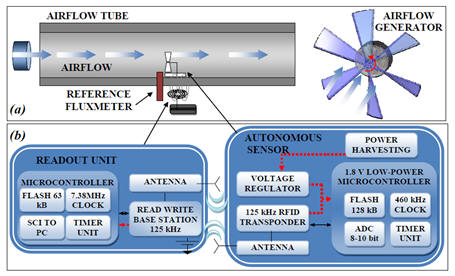
Air temperature and velocity measurements are important parameters in many applications. A self-powered sensor placed in a duct and powered by an electromechanical generator scavenging energy from the airflow has been designed and tested. It periodically transmits the measured air temperature and velocity to a receiving unit. The system basically consists of two macroblocks, respectively: the self-power wireless sensor and the receiving unit. The self powered sensor has a section devoted to the energy harvesting, exploiting the movement of an airscrew shaft keyed to a dc motor. The self-powered sensor adopts integrated devices in low-power technology, including a microcontroller, an integrated temperature sensor, and a radio-frequency transmitter at 433 MHz. The data transmission is realized in Manchester encoding, with amplitude-shift-keying modulation at 433 MHz, allowing covering a distance between the sensor and the reader on the order of 4–5 m, depending on the power supplied in transmission. The air velocity is measured through the rotor frequency of the electromechanical generator, whereas, for the temperature, a commercial low-power sensor is used. An experimental system has been designed and fabricated, demonstrating that the airflow harvester can power the self-powered wireless sensor permitting air temperature and velocity measurements. The system can be used for real-time monitoring of temperature and velocity. The sensor module placed into the duct does not require any batteries.
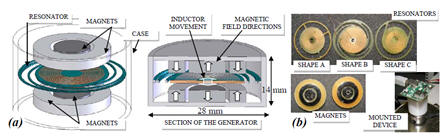
Autonomous sensors are receiving increasing interest, mostly because they offer flexibility for measurements into inaccessible location. Moreover, measurement application requiring long-lived capability does not commonly match the performance of the batteries. An autonomous sensor consisting of completely embedded structures with no physical links to the outside world, exploiting power from the ambient sources is an alternative solution. An electromechanical power generator is proposed for converting mechanical energy in the form of vibrations available in the measurement environment into electrical energy. The operating principle is based on the relative movement of a planar inductor with respect to permanent magnets. A specific configuration of magnets is proposed and analyzed with the aim to improve the conversion efficiency, increasing the spatial variation of magnetic flux. Furthermore, the proposed configuration can be adopted for its low profile and modularity.