Wireless, passive and autonomous sensing technologies enable measurements in applications where cables, batteries or conventional active electronics cannot be easily used.
Our research focuses on the design and development of passive wireless sensors, contactless telemetric measurement systems, self-powered sensors and autonomous measurement devices, with particular attention to harsh environments, inaccessible locations, biomedical implants and smart objects.
The research combines sensing technologies, inductive and electromagnetic coupling, low-power electronics, energy harvesting, wireless communication and metrological characterization to develop measurement systems capable of operating with minimal or no local energy supply.
Passive and Contactless Telemetric Sensors
Passive sensing systems are particularly attractive when the sensor must operate in an enclosed, hermetic, inaccessible or harsh environment where active electronics and batteries cannot be installed or periodically maintained.
Our research investigates telemetric systems in which a passive sensing element is remotely interrogated through inductive or electromagnetic coupling.
Research topics include:
- passive wireless sensors
- contactless measurement systems
- inductive telemetry
- passive resistive sensors
- passive capacitive sensors
- impedance-based readout
- resonant sensing
- wireless sensor interrogation
- batteryless sensing
- measurements in hermetic and inaccessible environments
A significant development in this field is presented in Telemetric Technique for Passive Resistive Sensors Based on Impedance Real Part Measurement at Fixed Frequency, where a passive resistive sensor is remotely measured through an inductively coupled telemetric system using impedance measurements at a fixed frequency.
More recently, passive telemetry has also been combined with printed electronics, as investigated in Preliminary Study on Wireless Passive Resistive Sensor Applied for Smart Objects.
Resonant and Inductive Sensors
Resonant sensing represents an effective approach for developing batteryless and contactless measurement systems.
In these systems, the sensing element modifies the resonance characteristics of a passive structure, while excitation and readout are performed remotely.
Our research has investigated:
- LC resonant sensors
- inductively coupled sensors
- passive MEMS
- contactless excitation
- contactless resonant readout
- electromagnetic coupling
- telemetric temperature sensors
- telemetric humidity sensors
- high-temperature sensing
- harsh-environment measurements
The Wireless Measurement Electronics for Passive Temperature Sensor was developed for contactless temperature measurements in harsh and hermetic environments using a fully passive sensing element and external readout electronics.
Contactless excitation and interrogation of mechanical resonators were also investigated in Numerical and Experimental Investigation on Contactless Resonant Sensors and Contactless Electromagnetic Excitation of Resonant Sensors Made of Conductive Miniaturized Structures.
These approaches are particularly relevant when sensing devices must operate without direct electrical connections or local active electronics.
Energy Harvesting and Self-Powered Sensors
Energy harvesting enables sensors and measurement electronics to operate using energy available from the surrounding environment, reducing or eliminating the need for conventional batteries.
Our research has investigated different energy conversion mechanisms and their integration into autonomous sensing systems.
Main topics include:
- energy harvesting
- energy scavenging
- electromagnetic generators
- vibration energy harvesting
- kinetic energy harvesting
- thermal energy harvesting
- human-motion energy harvesting
- power management
- low-power electronics
- self-powered wireless sensors
An overview of the architectures and design strategies for these systems is presented in Passive and Self-Powered Autonomous Sensors for Remote Measurements.
Electromagnetic energy conversion for low-frequency applications was investigated in An Efficient Electromagnetic Power Harvesting Device for Low-Frequency Applications.
A complete autonomous sensor powered directly by the measured airflow was demonstrated in Self-Powered Wireless Sensor for Air Temperature and Velocity Measurements With Energy Harvesting Capability.
Autonomous Wearable and Biomedical Systems
Energy harvesting and low-power design are particularly relevant for wearable and biomedical measurement systems, where battery size, operating lifetime and maintenance represent important constraints.
Our research has investigated autonomous wearable systems capable of measuring physiological parameters while reducing dependence on conventional power sources.
In Autonomous Wearable System for Vital Signs Measurement With Energy-Harvesting Module, an autonomous wearable device was developed for vital-sign monitoring using an integrated energy-harvesting module.
This research combines:
- wearable sensing
- vital-sign monitoring
- low-power measurement electronics
- autonomous sensor nodes
- wireless data transmission
- renewable energy sources
- energy management
Autonomous and Self-Powered Implantable Sensors
Implantable measurement systems represent one of the most challenging applications for autonomous sensing because battery replacement and wired connections are generally undesirable or impossible.
Our research investigated autonomous sensors integrated into total knee prostheses for measuring mechanical loads and transmitting measurement information outside the body.
The feasibility of autonomous force sensing inside a knee implant was investigated in Design and Test of an Autonomous Sensor for Force Measurements in Human Knee Implants.
Energy harvesting from human knee motion was subsequently studied as a possible power source for implantable electronics. The main results are presented in An Energy Harvesting Converter to Power Sensorized Total Human Knee Prosthesis.
A broader analysis of power-generation approaches for implantable biomedical devices is provided in Kinetic and Thermal Energy Harvesters for Implantable Medical Devices and Biomedical Autonomous Sensors.
The complete concept was later developed toward an implantable autonomous measurement device in Implantable Autonomous Device for Wireless Force Measurement in Total Knee Prosthesis.
Low-Power Electronics and Autonomous Measurement
The development of autonomous sensing systems requires the optimization of the complete measurement chain rather than the sensing element alone.
Research activities therefore include:
- ultra-low-power electronic design
- sensor signal conditioning
- power management
- wireless transmission
- duty-cycled measurements
- impedance measurement electronics
- autonomous data acquisition
- energy-aware measurement strategies
The objective is to minimize the energy required for sensing, signal processing and wireless communication while maintaining adequate measurement performance.
Selected Publications
Journal Articles
Passive and Self-Powered Autonomous Sensors for Remote Measurements
E. Sardini, M. Serpelloni
Sensors, 9(2), pp. 943–960, 2009.
This review presents the main architectures and design principles of passive and self-powered autonomous sensors, including sensing strategies, telemetry, power management and energy-harvesting approaches for remote and harsh-environment measurements.
Telemetric Technique for Passive Resistive Sensors Based on Impedance Real Part Measurement at Fixed Frequency
M. Bona, M. Borghetti, E. Sardini, M. Serpelloni
IEEE Transactions on Instrumentation and Measurement, 67(9), pp. 2160–2168, 2018.
The paper proposes a telemetric measurement technique for passive resistive sensors based on the real part of system impedance measured at a fixed frequency.
Autonomous Wearable System for Vital Signs Measurement With Energy-Harvesting Module
A. Dionisi, D. Marioli, E. Sardini, M. Serpelloni
IEEE Transactions on Instrumentation and Measurement, 65(6), pp. 1423–1434, 2016.
This work presents an autonomous wearable measurement system powered by an energy-harvesting module for monitoring vital signs.
Kinetic and Thermal Energy Harvesters for Implantable Medical Devices and Biomedical Autonomous Sensors
A. Cadei, A. Dionisi, E. Sardini, M. Serpelloni
Measurement Science and Technology, 25(1), 012003, 2014.
This work reviews kinetic and thermal energy-harvesting technologies for implantable medical devices and autonomous biomedical sensors.
DOI: 10.1088/0957-0233/25/1/012003
An Energy Harvesting Converter to Power Sensorized Total Human Knee Prosthesis
V. Luciano, E. Sardini, M. Serpelloni, G. Baronio
Measurement Science and Technology, 25(2), 025702, 2014.
The study investigates an electromagnetic energy-harvesting system integrated into a total knee prosthesis to provide energy for implantable sensing and measurement electronics.
DOI: 10.1088/0957-0233/25/2/025702
Wireless Measurement Electronics for Passive Temperature Sensor
E. Sardini, M. Serpelloni
IEEE Transactions on Instrumentation and Measurement, 61(9), pp. 2354–2361, 2012.
The work presents a contactless measurement system for a fully passive temperature sensor, designed for high-temperature and hermetic environments where conventional electronics cannot operate.
Self-Powered Wireless Sensor for Air Temperature and Velocity Measurements With Energy Harvesting Capability
E. Sardini, M. Serpelloni
IEEE Transactions on Instrumentation and Measurement, 60(5), pp. 1838–1844, 2011.
This work demonstrates a self-powered wireless sensor for air temperature and velocity measurements, powered by an electromechanical generator harvesting energy directly from airflow.
An Efficient Electromagnetic Power Harvesting Device for Low-Frequency Applications
E. Sardini, M. Serpelloni
Sensors and Actuators A: Physical, 172(2), pp. 475–482, 2011.
The work investigates an electromagnetic generator optimized for low-frequency vibration energy harvesting, relevant to autonomous sensor powering.
DOI: 10.1016/j.sna.2011.09.013
Numerical and Experimental Investigation on Contactless Resonant Sensors
B. Andò, S. Baglio, M. Baù, V. Ferrari, E. Sardini, N. Savalli, M. Serpelloni, C. Trigona
Sensors and Actuators A: Physical, 162(2), pp. 329–335, 2010.
This work investigates passive MEMS resonators remotely excited and interrogated through electromagnetic coupling, enabling contactless measurements without local active electronics.
DOI: 10.1016/j.sna.2010.04.009
Implantable Autonomous Device for Wireless Force Measurement in Total Knee Prosthesis
M.A. Khan, M. Borghetti, M. Serpelloni, E. Sardini
IEEE Instrumentation & Measurement Magazine, 22(1), pp. 39–47, 2019.
The work presents an implantable autonomous device for wireless force measurement inside a total knee prosthesis, combining sensing, autonomous operation and wireless telemetry.
Related Conference Papers
Preliminary Study on Wireless Passive Resistive Sensor Applied for Smart Objects
M. Borghetti, E. Cantù, E. Sardini, M. Serpelloni
2021 IEEE International Workshop on Metrology for Industry 4.0 and IoT, pp. 150–155, 2021.
The work combines printed electronics and passive wireless telemetry, investigating printed coils and capacitors for wireless interrogation of resistive sensors integrated into smart objects.
DOI: 10.1109/MetroInd4.0IoT51437.2021.9488452
Power Harvesting Integrated in a Knee Implant for Autonomous Sensors Implanted in Human Body
D. Marioli, E. Sardini, M. Serpelloni
2015 IEEE International Symposium on Medical Measurements and Applications (MeMeA), pp. 462–466, 2015.
This work investigates an energy-harvesting system integrated into a knee implant to power autonomous sensing electronics inside the human body.
DOI: 10.1109/MeMeA.2015.7145248
An Autonomous Sensor with Energy Harvesting Capability for Airflow Speed Measurements
A. Flammini, D. Marioli, E. Sardini, M. Serpelloni
2010 IEEE International Instrumentation and Measurement Technology Conference (I2MTC), pp. 892–897, 2010.
The work presents an autonomous sensor in which airflow provides both the quantity to be measured and the energy required to operate the measurement system.
DOI: 10.1109/IMTC.2010.5488264
Related Research Areas
Printed passive sensing elements and their integration into smart objects are presented in Printed and Flexible Electronics.
Additive fabrication of printed coils, capacitors and sensing structures is described in Aerosol Jet Printing and Additive Manufacturing of Sensors.
Wearable and rehabilitation applications are presented in Wearable and Biomedical Measurement Systems.
A complete list of journal articles and conference papers is available in the Publications section.
The monitoring of any human physiological parameters during rehabilitation exercises requires noninvasive sensors for the patient. This paper describes a wireless wearable T-shirt for posture monitoring during rehabilitation or reinforcement exercises. The subject posture is measured through a sensorized T-shirt using an inductive sensor sewn directly on the fabric. The wireless wearable T-shirt design specifications are the following: independence from the remote unit, easy to use, lightweight and comfort of wearing. This paper reports the conceptual framework, the fabricated device description, and the adopted experimental setup. The instrumented T-shirt’s output data are compared with the data obtained via an optical system, as a gold standard, that measures the marker positions over the patient’s back and chest. The trials performed on four subjects obtained on different days demonstrate that the wireless wearable sensor described in this paper is capable of producing reliable data compared with the data obtained with the optical system. The constitutive sensor simplicity that includes only a copper wire and a separable circuit board allows achieving the objectives of simplicity, ease of use, and noninvasiveness. The sensorized T-shirt, integrated with designed conditioning and transmission electronics for remote communication, could be used as a support tool for postural monitoring during rehabilitation exercises. © 1963-2012 IEEE.
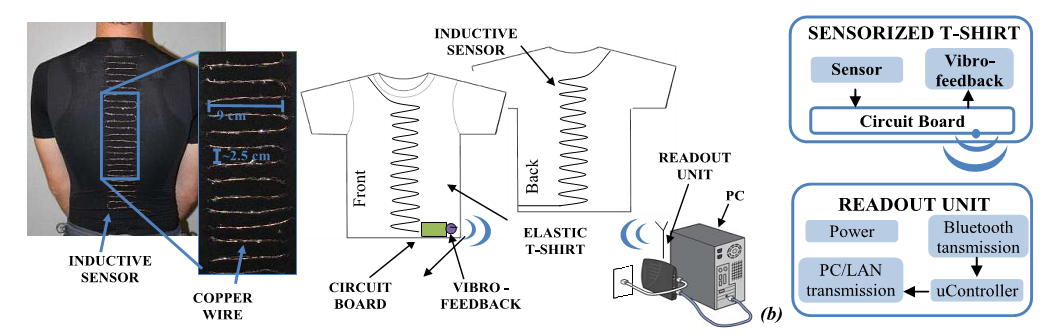
Sardini, E., Serpelloni, M., Pasqui, V. Wireless wearable t-shirt for posture monitoring during rehabilitation exercises (2015) IEEE Transactions on Instrumentation and Measurement, 64 (2), art. no. 6879298, pp. 439-448. DOI:10.1109/TIM.2014.2343411
Wireless wearable t-shirt for posture monitoring during rehabilitation exercises
TONGUE PRESSURE SENSORS
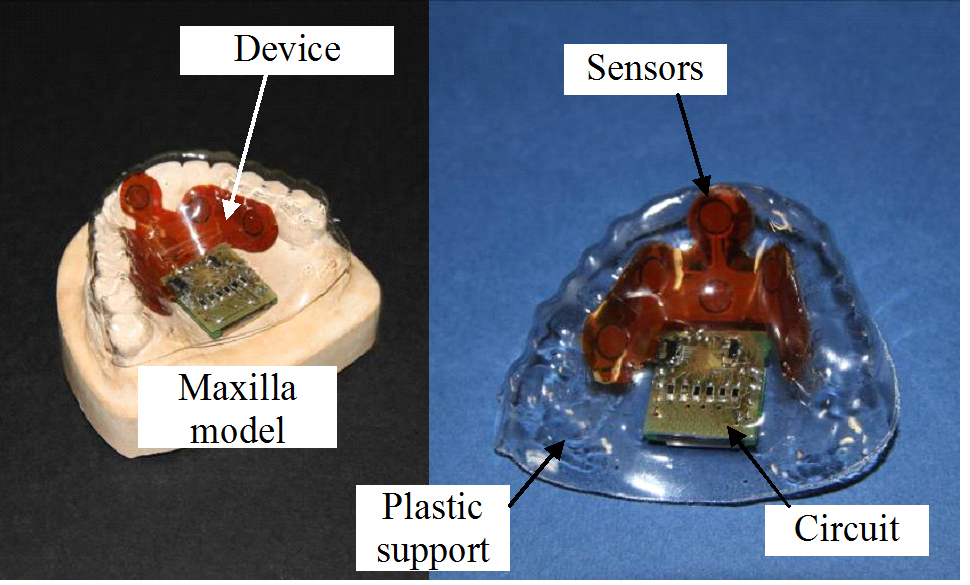
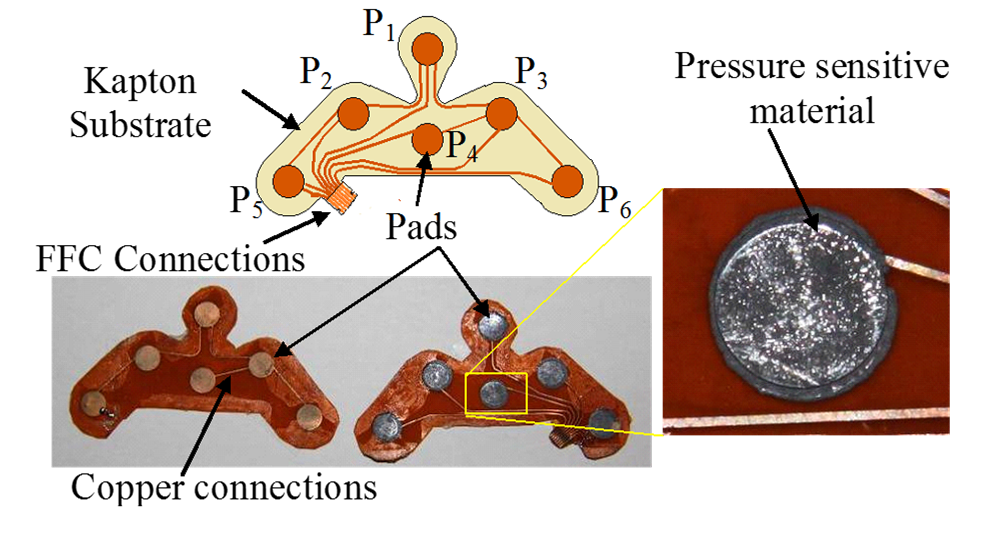
The tongue is an important muscle and the contact with the hard palate during the articulation of a syllable or during swallowing is fundamental. Patients who have had cerebrovascular or other neurological disorders may have impaired speech and swallowing problems due to decreased ability to control the tongue. In this work, a device with the aim of providing a non-invasive aid for the rehabilitation is described. The proposed device has been designed with the purpose of measuring the tongue pressure on the palate directly in the oral cavity and transmitting the data wirelessly. The device is minimally invasive, because no cable is used to connect the pressure sensor placed in the oral cavity with the reading unit placed outside. A first prototype was developed and preliminary testing data for the analysis of the sensor behavior have been performed. A specific experimental setup has been designed and realized and a testing protocol has been defined and adopted. The obtained preliminary experimental results show a wide measurement range, up to 100 kPa. Application fields of this device are the treatment of people with swallowing or phonetic disorders. © 2014 IEEE.