Wearable and biomedical measurement systems enable the continuous and quantitative monitoring of human movement, physiological parameters, interaction forces and rehabilitation activities outside conventional laboratory environments.
Our research focuses on the design, development and metrological characterization of wearable sensors, instrumented assistive devices and biomedical measurement systems, with particular attention to rehabilitation, gait analysis, human movement monitoring and wearable technologies.
The research combines sensors, electronic instrumentation, wireless communication, signal processing and biomechanical analysis to develop measurement systems that can provide quantitative information during daily activities, clinical assessment and rehabilitation.
Instrumented Crutches and Assisted Gait Monitoring
A major research activity concerns the development of sensorized and instrumented crutches for quantitative gait and rehabilitation monitoring.
Instrumented walking aids can provide information that is normally unavailable from visual observation alone, including axial and shear forces, crutch inclination, timing and partial weight-bearing.
Our research has led to the development and validation of wireless instrumented forearm crutches for measuring forces and movement during assisted gait.
The first complete system was presented in Wireless Instrumented Crutches for Force and Movement Measurements for Gait Monitoring, where strain-gauge bridges and inertial sensing were integrated into conventional crutches to provide quantitative information during walking.
The technology was subsequently applied to exoskeleton-assisted rehabilitation in Healthcare Sensor System Exploiting Instrumented Crutches for Force Measurement during Assisted Gait of Exoskeleton Users.
More recently, the instrumented-crutch approach has been further investigated in Validation of a Sensorized Forearm Crutch for Quantifying Partial Weight-Bearing During Assisted Gait Using Optical Motion Capture and Instrumented Treadmill, published in 2026.
Current research topics include:
- instrumented crutches
- sensorized walking aids
- partial weight-bearing measurement
- assisted gait monitoring
- force measurement during gait
- gait analysis
- rehabilitation monitoring
- exoskeleton-assisted gait
- inertial measurement
- biomechanical assessment
Smart Orthoses and Rehabilitation Devices
Another research activity concerns the integration of sensors directly into orthoses, braces and rehabilitation devices.
Sensorized orthoses can provide quantitative information on joint motion, muscle activation and interaction forces while maintaining a compact and wearable configuration.
The Smart Brace for Static and Dynamic Knee Laxity Measurement was developed to provide quantitative measurements of knee laxity under both static and dynamic conditions.
Additive manufacturing technologies have also been investigated for integrating sensing elements directly onto orthotic devices. In Printed Multi-EMG Electrodes on the 3D Surface of an Orthosis for Rehabilitation: A Feasibility Study, printed electrodes were fabricated directly on the three-dimensional surface of an orthosis for electromyographic monitoring.
More recently, research has been extended to instrumented ankle-foot orthoses and smart 3D-printed orthoses.
Main research topics include:
- smart orthoses
- sensorized braces
- knee monitoring
- ankle-foot orthoses
- rehabilitation devices
- electromyography
- printed EMG electrodes
- wearable biomechanical measurements
- integration of sensors into 3D structures
Wearable Human Movement Monitoring
Wearable measurement systems provide the possibility of monitoring human motion during normal activities without requiring complex laboratory instrumentation.
Our research investigates wearable devices for measuring joint motion, limb movement, posture and hand/finger movements using inertial, resistive, capacitive, magnetic and other sensing technologies.
The Multi Sensor System for Analyzing the Thigh Movement during Walking combines different sensing principles to monitor thigh movement during walking in free-living conditions.
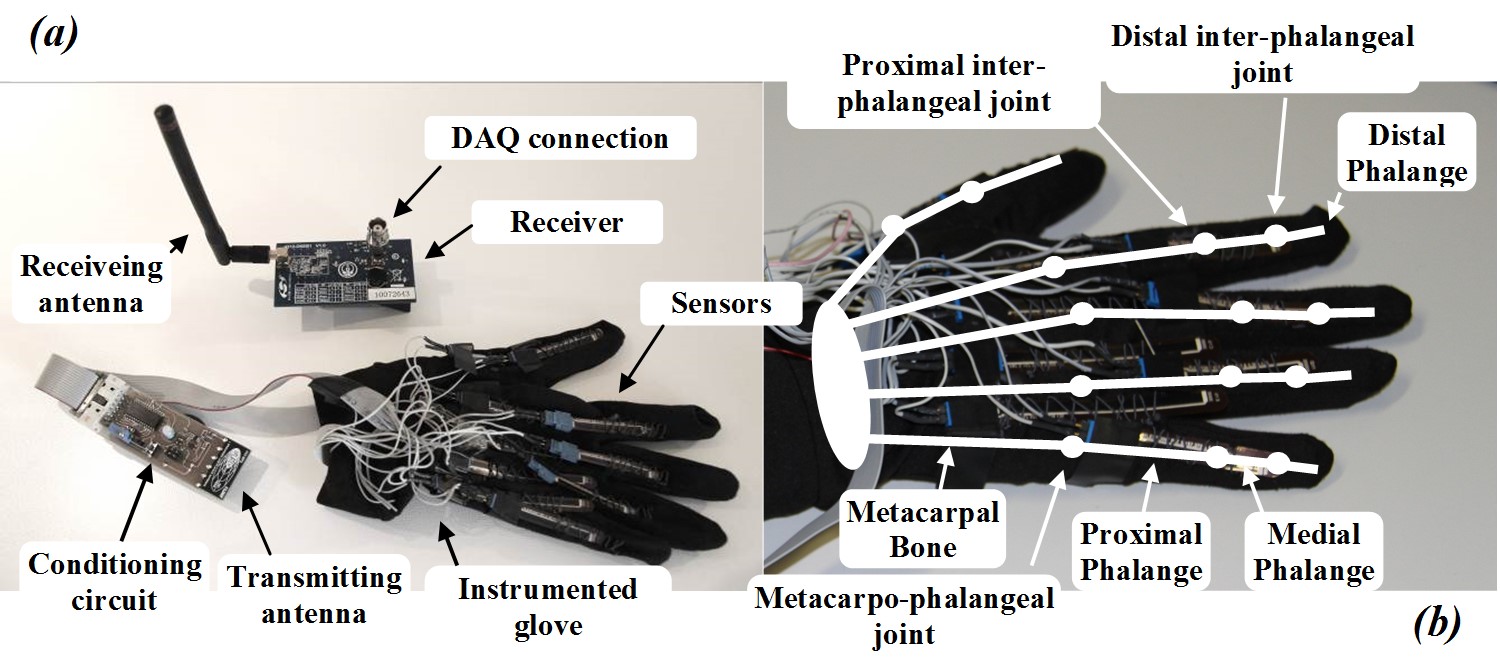
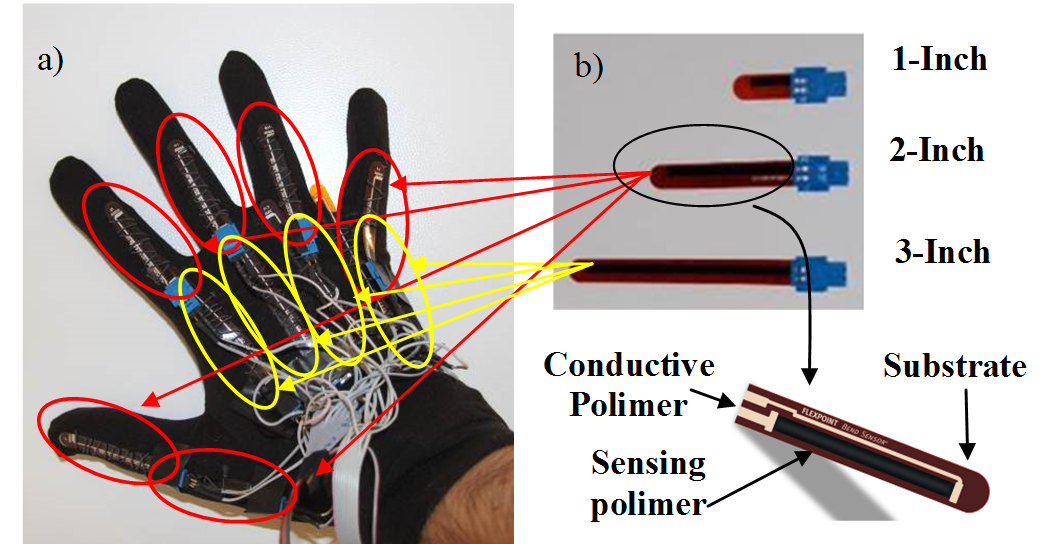
Hand and finger movements have also been extensively investigated. The Sensorized Glove for Measuring Hand Finger Flexion for Rehabilitation Purposes introduced a wearable solution for quantitative finger-flexion measurements.
This research was subsequently extended through systems such as A Wearable and Wirelessly Powered System for Multiple Finger Tracking and Validation of a Modular and Wearable System for Tracking Fingers Movements.
More recently, smart gloves have been investigated for human–device interaction and light-mobility applications, including Novel Smart Glove for Ride Monitoring in Light Mobility.
Wearable Posture Monitoring
Wearable systems can also provide quantitative information on body posture during rehabilitation exercises and daily activities.
The Wireless Wearable T-Shirt for Posture Monitoring During Rehabilitation Exercises integrates sensing elements directly into a garment to provide non-invasive monitoring of body posture.
The objective of this research is to develop unobtrusive measurement systems capable of providing quantitative information while minimizing interference with the user’s normal movement.
Research topics include:
- wearable posture monitoring
- sensorized garments
- smart textiles
- body movement monitoring
- rehabilitation exercises
- home rehabilitation
- remote patient monitoring
Metrological Characterization and Validation
Wearable and biomedical sensors must provide reliable quantitative measurements despite being used under conditions that are less controlled than those of conventional laboratory instrumentation.
For this reason, an important part of our research concerns the metrological characterization and experimental validation of wearable measurement systems.
Particular attention is devoted to:
- calibration
- sensitivity
- accuracy
- repeatability and reproducibility
- hysteresis
- drift
- measurement uncertainty
- sensor placement
- inter-subject variability
- comparison with reference measurement systems
- validation during realistic human movements
Reference systems including optical motion capture, instrumented treadmills and laboratory force-measurement systems are used when appropriate to assess wearable sensor performance.
Selected Publications
Journal Articles
Validation of a Sensorized Forearm Crutch for Quantifying Partial Weight-Bearing During Assisted Gait Using Optical Motion Capture and Instrumented Treadmill
S. Mahraoui, G. Bücken, S. Ecker, S.I. Shakir, A.-P. Schulz, N. Muhametaj, M. Serpelloni
Sensors, 26(13), 4191, 2026.
This work provides a recent experimental validation of a sensorized forearm crutch for quantitative partial weight-bearing assessment, using optical motion capture and an instrumented treadmill as reference measurement systems.
Novel Smart Glove for Ride Monitoring in Light Mobility
M. Borghetti, N.F. Lopomo, M. Serpelloni
Instruments, 9(1), 6, 2025.
This work presents a wearable smart glove for quantitative monitoring of hand interaction and grip during light-mobility activities.
DOI: 10.3390/instruments9010006
Smart Brace for Static and Dynamic Knee Laxity Measurement
P. Bellitti, M. Borghetti, N.F. Lopomo, E. Sardini, M. Serpelloni
Sensors, 22(15), 5815, 2022.
The study presents a wearable smart brace designed for quantitative static and dynamic knee laxity measurements, combining sensing technologies with a conventional orthopedic device.
Printed Multi-EMG Electrodes on the 3D Surface of an Orthosis for Rehabilitation: A Feasibility Study
E. Cantù, T. Fapanni, G. Giorgi, C. Narduzzi, E. Sardini, M. Serpelloni, S. Tonello
IEEE Sensors Journal, 21(13), pp. 14407–14417, 2021.
This work investigates the direct integration of printed electromyographic electrodes on the three-dimensional surface of an orthosis, opening new opportunities for sensorized rehabilitation devices.
DOI: 10.1109/JSEN.2021.3059308
A Wearable and Wirelessly Powered System for Multiple Finger Tracking
P. Bellitti, A. De Angelis, M. Dionigi, E. Sardini, M. Serpelloni, A. Moschitta, P. Carbone
IEEE Transactions on Instrumentation and Measurement, 69(5), pp. 2542–2551, 2020.
The paper presents a wearable system for tracking multiple finger movements, combining wearable sensing with wireless powering and measurement electronics.
Validation of a Modular and Wearable System for Tracking Fingers Movements
M. Borghetti, P. Bellitti, N.F. Lopomo, M. Serpelloni, E. Sardini
Acta IMEKO, 9(4), pp. 157–164, 2020.
This work focuses on the experimental validation of a modular wearable measurement system for tracking finger movements.
DOI: 10.21014/acta_imeko.v9i4.752
Multi Sensor System for Analyzing the Thigh Movement during Walking
M. Borghetti, M. Serpelloni, E. Sardini, O. Casas
IEEE Sensors Journal, 2017.
The proposed wearable multi-sensor system combines different sensing technologies to quantitatively monitor thigh movement during walking and running.
DOI: 10.1109/JSEN.2017.2715857
Healthcare Sensor System Exploiting Instrumented Crutches for Force Measurement during Assisted Gait of Exoskeleton Users
M. Lancini, M. Serpelloni, S. Pasinetti, E. Guanziroli
IEEE Sensors Journal, 16(23), pp. 8228–8237, 2016.
This work applies instrumented crutches to exoskeleton-assisted gait, combining force measurements and biomechanical analysis to obtain quantitative information on patient and therapist interaction.
DOI: 10.1109/JSEN.2016.2579738
Wireless Instrumented Crutches for Force and Movement Measurements for Gait Monitoring
E. Sardini, M. Serpelloni, M. Lancini
IEEE Transactions on Instrumentation and Measurement, 2015.
The paper describes the design, characterization and experimental evaluation of wireless instrumented forearm crutches capable of measuring axial and shear forces, inclination and gait-related parameters.
Wireless Wearable T-Shirt for Posture Monitoring During Rehabilitation Exercises
E. Sardini, M. Serpelloni, V. Pasqui
IEEE Transactions on Instrumentation and Measurement, 64(2), pp. 439–448, 2015.
This work presents a wireless sensorized garment for posture monitoring during rehabilitation exercises, designed to provide non-invasive measurements of body posture.
Related Conference Papers
Aerosol-Jet Printed and Photonically Cured Sensors Embedded in 3D-Printed Smart Orthoses: A Preliminary Study
L. Rossetti, M. Borghetti, M. Serpelloni
2026 IEEE International Workshop on Metrology for Industry 4.0 and IoT, 2026.
This recent work investigates the direct integration of printed sensors into 3D-printed smart orthoses, combining wearable measurement systems with additive manufacturing.
Wireless Instrumented Ankle Foot Orthosis (AFO) for Gait Cycle Monitoring: A Preliminary Study
S. Mahraoui, M. Serpelloni
2025 IEEE International Workshop on Metrology for Industry 4.0 and IoT, pp. 89–94, 2025.
The study investigates a wireless instrumented ankle-foot orthosis for monitoring the gait cycle, extending wearable rehabilitation monitoring to sensorized orthotic devices.
DOI: 10.1109/MetroInd4.0IoT66048.2025.11122054
Printed Soft Capacitive Sensor for Fingertip Contact Monitoring
P. Bellitti, M. Borghetti, E. Sardini, M. Serpelloni
2025 IEEE International Workshop on Metrology for Industry 4.0 and IoT, pp. 151–156, 2025.
The work presents a soft printed capacitive sensor for fingertip contact monitoring, relevant to wearable interfaces and hand-interaction measurement systems.
DOI: 10.1109/MetroInd4.0IoT66048.2025.11121948
Characterization Method for Bending Sensor Applied for Smart Glove
M. Borghetti, N.F. Lopomo, M. Serpelloni
2024 IEEE International Workshop on Metrology for Industry 4.0 and IoT, pp. 524–529, 2024.
This work focuses on the metrological characterization of bending sensors for smart-glove applications.
DOI: 10.1109/MetroInd4.0IoT61288.2024.10584213
Related Research Areas
Printed sensing technologies and sensor integration into flexible substrates are presented in Printed and Flexible Electronics.
Additive fabrication and direct printing of sensors onto orthoses and three-dimensional devices are described in Aerosol Jet Printing and Additive Manufacturing of Sensors.
Wearable chemical sensors and biosensing systems are presented in Printed Electrochemical Sensors, Biosensors and Ion-Selective Sensors.
Wireless powering, passive sensing and energy-autonomous biomedical devices are presented in Wireless, Passive and Autonomous Sensors.
A complete list of journal articles and conference papers is available in the Publications section.

Sensorized Glove for Measuring Hand Finger Flexion for Rehabilitation Purposes
Over the last 30 years, scientific and technological progress has boosted the development of medical devices that can assist patients and support medical staff. With regard to the rehabilitation of patients who have suffered from traumas, robotic systems can be an aid for rapid patient recovery. This paper focuses on studying and implementing a system for measuring the finger position of one hand with the aim of giving feedback to the rehabilitation system. It consists of a glove where sensors are mounted suitably configured and connected to an electronic conditioning and acquisition unit. The information regarding the position is then sent to a remote system. The objective of this paper is to provide a sensorized glove for monitoring the rehabilitation activities of the hand. The glove can have several other applications such as: 1) the recognition of sign language; 2) the diagnostic measurement of the finger movement at a distance; and 3) the interaction with virtual reality.